Making maintenance decisions based on evidence rather than assumptions
For decades, inspection strategies in the Oil & Gas industry have shared one primary objective: ensuring the integrity of critical assets while maintaining production continuity.
Pressure vessels, compressors, pumps, heat exchangers, process piping and rotating equipment operate under constant mechanical, thermal and chemical stress. Throughout their service life, they are exposed to corrosion, erosion, fatigue, vibration and a wide range of process-related degradation mechanisms.
Finding defects is still important.
But for today's Asset Integrity teams, the real challenge is different.
The critical question is no longer Can we detect degradation? It's Do we have enough evidence to make the right maintenance decision?
As operators seek to optimise maintenance budgets, extend asset life and minimise unnecessary shutdowns, inspection is becoming less about collecting data and more about reducing uncertainty before intervention begins.
The hidden cost of uncertainty
Maintenance decisions are rarely made with complete information.
Engineers frequently have to decide whether equipment can safely remain in service, whether intervention should wait until the next planned shutdown, or whether immediate maintenance is required.
Those decisions are often based on indirect indicators such as:
- Vibration analysis
- Thermography
- Process performance trends
- Lubricant analysis
- Historical inspection records
- Predictive maintenance data
These techniques remain essential components of modern Asset Integrity programmes. However, they rarely provide direct information about the physical condition of inaccessible internal components.
Without visual confirmation, engineering teams often adopt conservative maintenance strategies.
This can result in:
- Dismantling equipment that remains fit for service
- Replacing components with significant remaining life
- Discovering unexpected damage only after equipment has been opened
- Extending shutdown durations due to unplanned repairs
- Increasing labour, crane operations and logistics costs
In highly regulated industries, the financial impact of uncertainty often exceeds the cost of performing the inspection itself.
Why visual evidence changes engineering decisions
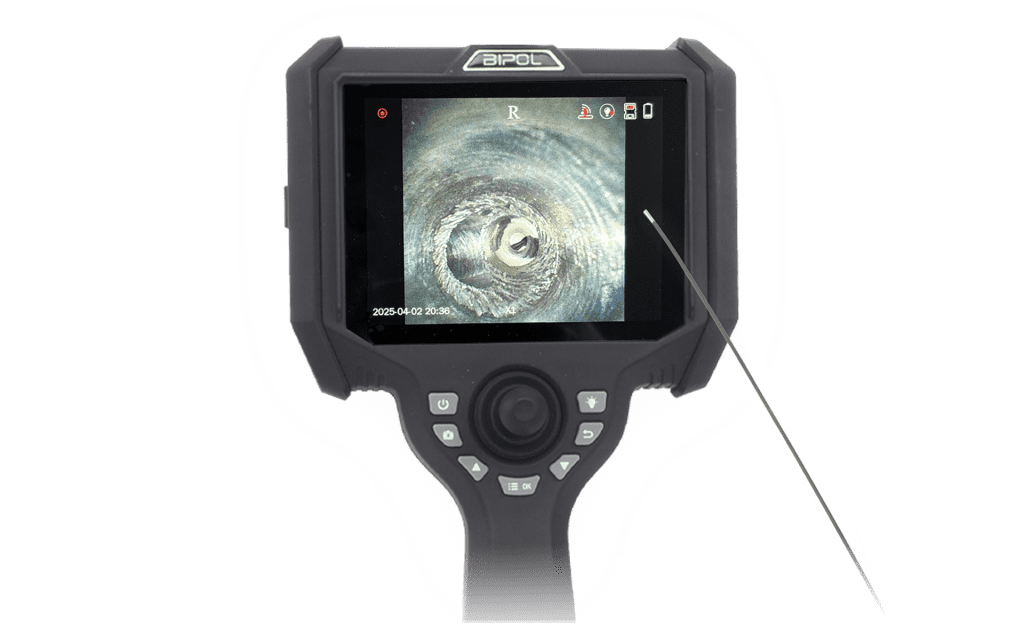
Remote Visual Inspection (RVI) occupies a unique position within the Non-Destructive Testing (NDT) toolbox.
Unlike techniques designed primarily to detect specific discontinuities, videoscopy provides direct visual access to the actual condition of internal surfaces and components.
For inspection engineers, this distinction is significant.
Visual evidence allows engineers to assess not only whether degradation exists, but also its location, morphology, distribution and progression.
Corrosion products, erosion patterns, coating degradation, deposits, foreign object damage, mechanical wear or thermal distress frequently reveal valuable information regarding the degradation mechanism itself.
This context is often essential when determining whether the observed condition represents an acceptable operational state or requires corrective action.
In practice, the value of videoscopy lies less in identifying defects than in improving engineering judgement.
Supporting Risk-Based Inspection rather than replacing it
Risk-Based Inspection (RBI) methodologies continue to represent the backbone of integrity management throughout the Oil & Gas sector.
Inspection intervals, maintenance priorities and resource allocation are increasingly determined by probability-of-failure and consequence-of-failure assessments.
Remote Visual Inspection should not be viewed as an alternative to RBI.
Instead, it provides additional condition data that strengthens engineering confidence when applying RBI principles.
By directly observing internal conditions before intrusive maintenance begins, engineering teams can:
- Validate degradation assumptions
- Confirm corrosion mechanisms
- Verify previous inspection findings
- Refine inspection scopes
- Prioritise maintenance activities according to actual asset condition
The result is not simply more inspection.
It is more informed inspection.
Improving shutdown efficiency
Planned shutdowns remain among the most resource-intensive activities in process industries.
Maintenance windows are tightly scheduled, contractor availability is limited and every additional hour has measurable financial consequences.
One of the most common causes of schedule deviation is discovering unexpected internal conditions after equipment has already been dismantled.
Remote Visual Inspection allows many of these uncertainties to be addressed before shutdown activities begin.
Pre-shutdown inspection campaigns enable maintenance planners to:
- Estimate intervention scope more accurately
- Identify equipment requiring priority attention
- Avoid opening components that remain in acceptable condition
- Prepare spare parts according to verified inspection findings
Rather than replacing shutdown inspections, videoscopy improves shutdown preparation.
Access: still one of the industry's greatest challenges
Many critical assets were never designed with inspection accessibility in mind.
Small access ports, complex internal geometries and long inspection paths frequently prevent engineers from obtaining meaningful visual information without significant dismantling.
Recent developments in micro-diameter videoscopy have considerably expanded inspection possibilities.
Ultra-small probes now allow engineers to access confined internal spaces while maintaining image quality suitable for engineering evaluation.
Applications continue to expand across:
- Control and process valves
- Compressors
- Centrifugal pumps
- Pressure vessels
- Heat exchangers
- Turbine systems
- Process piping
- Rotating machinery
In many situations, selecting the appropriate probe diameter determines whether meaningful inspection data can be obtained without opening the equipment.
From equipment supplier to inspection partner
As Remote Visual Inspection technology continues to evolve, selecting a videoscope should no longer be viewed as a simple purchasing decision.
Inspection success depends on far more than image resolution alone.
Probe diameter, articulation capability, insertion length, illumination and optical performance all influence the quality of inspection results depending on equipment geometry and inspection objectives.
For this reason, many organisations increasingly seek technical partners capable of understanding inspection challenges before recommending a particular solution.
The objective is not simply supplying a videoscope.
It is helping engineering teams obtain reliable visual evidence that improves maintenance planning, supports Asset Integrity programmes and enables more confident operational decisions.
Conclusion
The future of inspection within the Oil & Gas industry will not be defined by collecting more data.
It will be defined by collecting the right data before critical maintenance decisions are made.
Remote Visual Inspection has become an essential component of this approach.
Not because it replaces other Non-Destructive Testing methods, but because it provides something few inspection techniques can offer: direct visual evidence of the actual condition of inaccessible components.
For Asset Integrity Engineers, Inspection Specialists and Maintenance Managers, that visual evidence reduces uncertainty, strengthens engineering judgement and supports better-informed maintenance strategies.
Better maintenance decisions rarely come from collecting more inspection data.
They come from reducing uncertainty before intervention begins.
That is precisely where Remote Visual Inspection is creating value.